Why Fly Fishing for Beginners Is Easier Than You Think (And Where to Start in Canada)
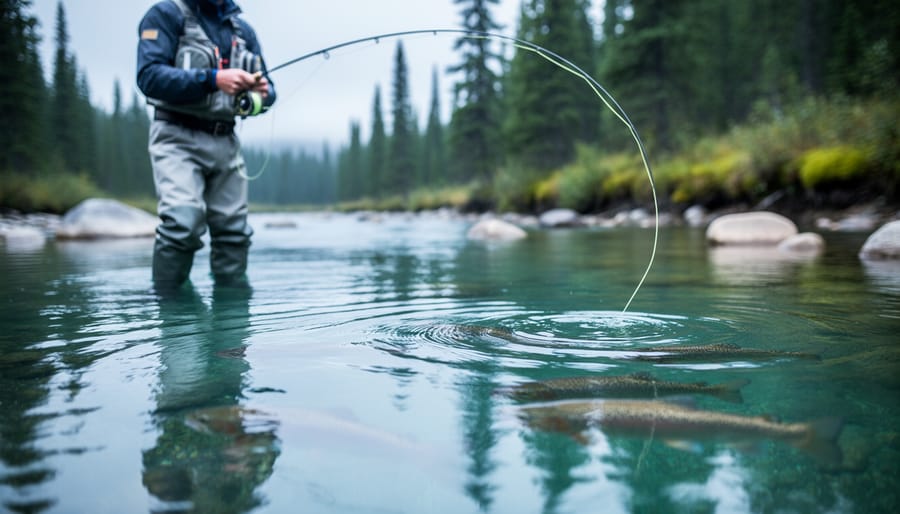
I still remember the first time I watched a fly fisher work a pristine Alberta creek, the line dancing through the air in graceful loops before settling gently on the water’s surface. It looked like poetry, and honestly, completely impossible for a regular person to learn.
That was fifteen years ago. Today, I spend dozens of days each season chasing trout across Canada’s best waters, and I can tell you this: fly fishing isn’t nearly as complicated or expensive as it looks from the outside. The truth is, you can get started with basic gear for around $200, learn the fundamental cast in an afternoon, and catch your first fish on a fly rod within your first few outings.
The confusion most beginners face doesn’t come from the sport being inherently difficult. It comes from outdated information, overcomplicated advice from well-meaning experts, and the intimidation factor of walking into a fly shop for the first time. You don’t need a $900 rod. You don’t need to tie your own flies on day one. You definitely don’t need to memorize Latin names of aquatic insects before you hit the water.
What you do need is a straightforward path forward. The right basic equipment that won’t break the bank or your spirit when you’re learning. A clear understanding of the essential techniques that actually matter in those first weeks. And most importantly, the knowledge of where to go in Canada to practice without feeling like you’re trespassing in someone’s private club.
This guide cuts through the noise. I’ll walk you through exactly what worked for me and hundreds of other anglers I’ve helped get started over the years. No gatekeeping, no unnecessary complexity, just the practical information you need to get on the water and start catching fish.
What Makes Fly Fishing Different (And Why That’s Actually Good News)
Here’s the honest truth that nobody told me when I started: fly fishing isn’t harder than regular fishing, it’s just different. And that difference is precisely what makes it more forgiving for beginners than you’d think.
When you spin fish or bait cast, you’re relying on the weight of your lure or sinker to pull the line out. You chuck it, reel it in, repeat. Fly fishing flips that completely. The weight is in the line itself, and you’re using the rod to load and unload energy in a back-and-forth rhythm. Your flies weigh almost nothing, which means you’re essentially casting the line and letting the fly go along for the ride.
I know that sounds complicated. It did to me too. But here’s the thing: once you understand that basic concept, the rest falls into place surprisingly quickly. You’re not trying to hurl something as far as possible. You’re creating a rhythm, a tempo, like painting the air with the line. It’s meditative. There’s no frantic reeling or aggressive yanking. Just you, the rod, and a repetitive motion that becomes muscle memory faster than you’d expect.
The biggest misconception beginners have is that fly fishing requires perfect technique from day one. Not true. I caught my first trout on a cast that would’ve made any instructor wince. The line piled up in a heap, the fly landed with all the grace of a dropped sock, but a hungry fish didn’t care. What matters early on is getting your fly in the general vicinity of where fish are holding and making it look semi-natural. Precision comes later.
Another fear I hear constantly: won’t I tangle everything into a mess? Yes, probably, especially in the first few sessions. Everyone does. But modern fly lines are designed to minimize tangles, and most Canadian waters where beginners start have plenty of open casting room. You’re not threading needles through overhanging branches on your first trip.
The rhythm of fly fishing also forces you to slow down and actually look at the water. You can’t just cast blindly and hope. You watch for rises, read current seams, notice where insects are hatching. This makes you a better angler overall, and it happens naturally because the technique demands it. Conventional fishing lets you zone out. Fly fishing keeps you present, which sounds like extra work but actually makes the whole experience more engaging and less frustrating.
Your First Fly Fishing Setup: What You Actually Need
The Rod and Reel Combo That Won’t Break the Bank
I spent my first season with a borrowed 9-foot 8-weight that was wildly overpowered for the trout streams I was fishing. Every cast felt like wrestling a sailboat mast, and I couldn’t understand why everyone said fly fishing was supposed to be graceful. Turns out, rod weight actually matters.
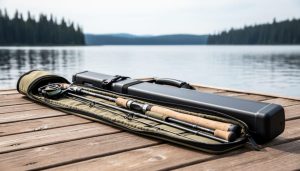
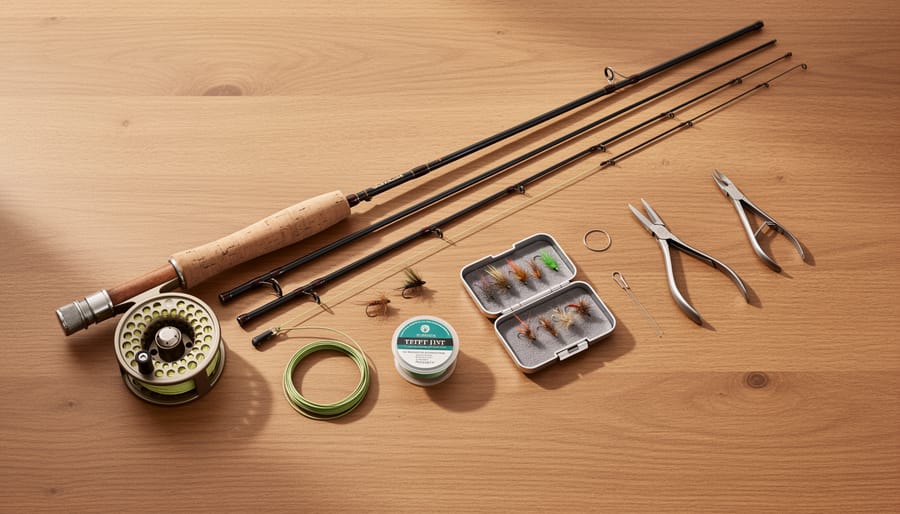
For most Canadian waters, a 9-foot 5-weight is the sweet spot for beginners. It handles everything from Ontario creek trout to Alberta rainbows without specialized knowledge. The length gives you casting distance and line control, while the 5-weight has enough backbone for wind but won’t overpower small fish. I’ve watched too many beginners struggle with 3-weights that can’t punch through our prairie winds or 8-weights that make every brook trout feel like reeling in a wet sock.
Budget around $200 to $300 for a decent combo that includes both rod and reel. Echo, Redington, and Orvis Clearwater all make reliable starter outfits in this range that won’t fall apart after a season. Skip the $80 big-box store specials, they’ll frustrate you enough to quit before you’ve really started. The extra hundred dollars buys you components that actually work together and won’t snap when you inevitably slam your rod tip in a car door.
One practical note: save money on accessories like your chest pack or wading staff, but invest in the rod and reel. You’ll be holding that setup for hours, and the difference between smooth and clunky becomes painfully obvious by your third outing.
Lines, Leaders, and Tippets Demystified
The fly line itself is thick and heavy, which is what carries your nearly weightless fly to the fish. Most beginners do well starting with a weight-forward floating line that matches their rod weight. If you bought a 5-weight rod, get a 5-weight line. Simple.
The leader is a tapered length of clear monofilament that connects your fly line to the fly. It transitions from thick at the line end to thin at the fly end. A 9-foot tapered leader works for most beginner situations. Buy a few pre-tapered leaders labeled 4X or 5X, which tells you the diameter at the thin end.
The tippet is additional thin line you tie to the leader’s end to replace what you lose when changing flies. Think of it as the sacrificial section. I burned through a whole spool my first week just practicing knots in my living room.
Here’s what saved me early on: buy one spool each of 4X and 5X tippet material. Lower numbers mean thicker line. For most trout fishing in Canada, 5X handles everything from small streams to bigger rivers. Save the specialized stuff for later when you actually understand why you’d need it.
The whole leader and tippet system just gives you an invisible connection between your visible fly line and your fly. That’s genuinely all beginners need to know.
Five Flies That Will Catch Fish Anywhere in Canada
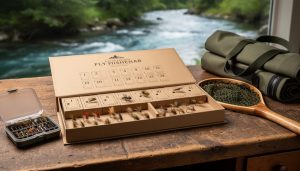
I keep five patterns in my vest that have saved me from getting skunked more times than I can count. The Woolly Bugger in black or olive works everywhere from Ontario bass waters to Alberta trout streams because it imitates leeches, baitfish, and who knows what else. A size 14 or 16 Elk Hair Caddis floats all day and catches everything that eats insects. The Copper John nymph drops below the surface where trout actually spend most of their feeding time. For versatility with your rainbow trout gear pair a Prince Nymph with almost any dry fly as a dropper. Finally, the Adams dry fly matches enough mayflies across Canada that it’s basically cheating.
These five cover surface feeding, subsurface feeding, and searching water when nothing’s visibly rising. Buy two of each pattern in a couple sizes. You’ll lose flies to trees, fish, and rocks, so having backups keeps you fishing instead of despairing. Later you’ll obsess over regional hatches and specialty patterns, but these workhorses will put fish in your net while you’re still learning to read the water.
Learning the Cast: How to Get Started Without Frustration
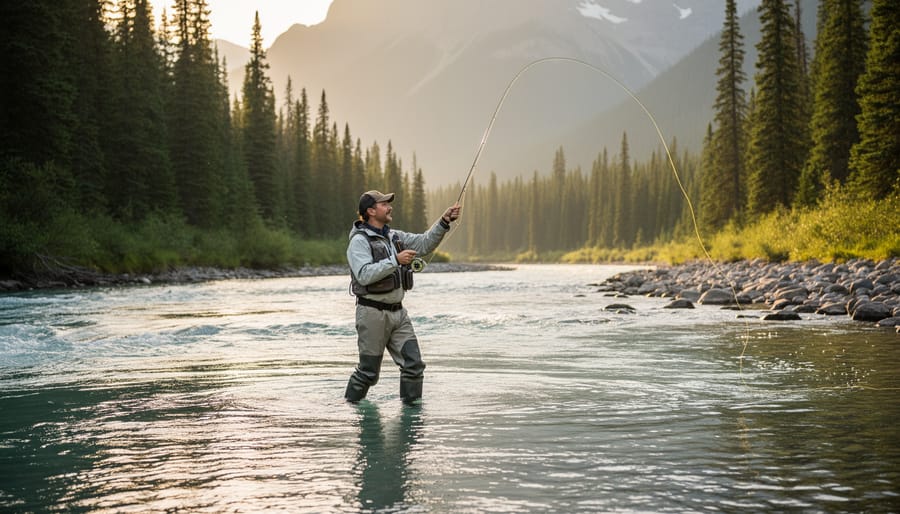
I spent my first hour with a fly rod tangled in my own jacket, whipping the line backward into a cedar tree, and nearly hooking myself in the ear. My friend Dave, who’d been fly fishing for years, just sat on his tailgate laughing. “You’re doing great,” he said between chuckles. “That tree didn’t even stand a chance.”
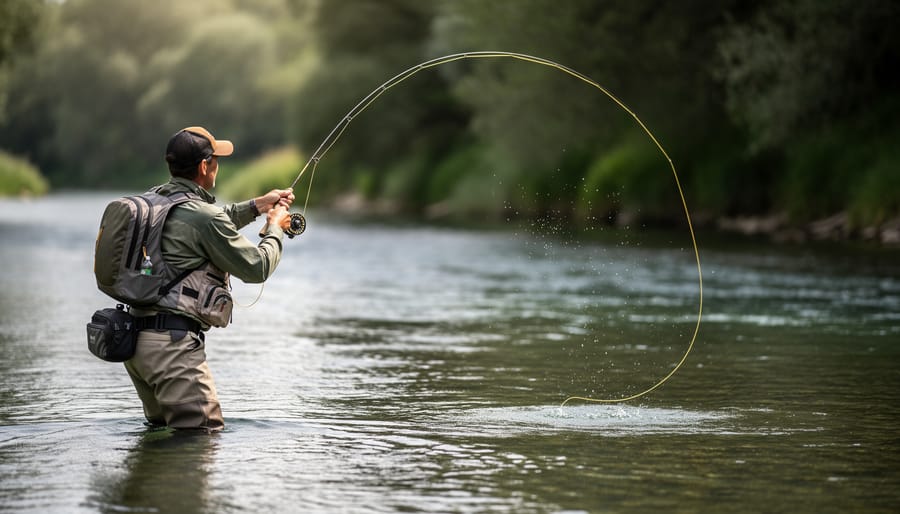
Here’s what nobody tells you upfront: the fly cast looks impossibly elegant when someone else does it, and feels like conducting an orchestra with wet spaghetti when you try it yourself. But the mechanics are actually simpler than you think, and you can learn the basics in your backyard with just a rod, some line, and a piece of yarn tied to the end instead of a fly.
Start by gripping the rod like you’re shaking hands with it. Your thumb should rest on top of the grip, pointing toward the rod tip. This felt weird to me at first because I wanted to choke up on it like a baseball bat, but that top-thumb position gives you the control you need for what comes next.
- Strip out about 20 feet of line and let it lie straight on the grass in front of you.
- Point the rod tip down at the line, keeping your elbow close to your body.
- Smoothly accelerate the rod backward to the one o’clock position, as if you’re trying to toss the line over your shoulder. Stop crisply.
- Pause while the line unfurls behind you. This is the hardest part because you can’t see it happening and every instinct screams to keep moving.
- Drive the rod forward to ten o’clock with the same smooth acceleration, stopping abruptly again.
- Lower the rod tip as the line shoots forward and settles on the grass.
That pause in step four is where I fell apart for weeks. I’d rush it, yanking the rod forward before the line straightened behind me, and everything would collapse in a heap. Dave finally told me to count “one-thousand-one” during the back cast, which felt ridiculously slow but actually worked.
Practice on grass, not water, for your first dozen sessions. Tie a small tuft of bright yarn to your tippet so you can see where it lands. Aim for a target like a hula hoop or a paper plate. You’ll develop muscle memory faster when you can watch the whole line movement without worrying about fish or current.
The breakthrough moment for me came in my backyard on a Tuesday evening. The line finally unfurled behind me properly, I felt that brief tug of resistance, and when I brought the rod forward, the whole thing laid out straight for the first time. It wasn’t perfect, but it was a cast. I stood there grinning like an idiot at an empty lawn.
Give yourself permission to be terrible for a while. Every smooth caster you see on the river started exactly where you are now.
Where Beginners Can Learn (Free Classes and Resources Across Canada)
The absolute easiest way to get started is finding someone who will teach you in person. I spent weeks watching YouTube videos before my first lesson, but fifteen minutes with a real instructor corrected mistakes I didn’t even know I was making.
Orvis runs free Fly Fishing 101 classes at their retail stores, and while most locations are in the U.S., they’re worth checking if you’re near the border or planning a trip. These sessions cover casting basics, knot tying, and reading water. Each participant receives a free one-year Trout Unlimited membership valued at 35 dollars, which connects you to local chapters and conservation efforts. The classes fill up quickly during spring, so register early if there’s a location within driving distance.
For dedicated Canadian options, the UNBC beginner fly class in Prince George offers a thorough introduction over four Wednesday evenings from 6:00pm to 9:00pm. This format gives you time to practice between sessions and ask questions as they come up, which I found more effective than trying to absorb everything in a single weekend workshop.
Many fly shops across the country run informal beginner clinics, especially in April and May before the season ramps up. These aren’t always advertised online, so call shops in your area and ask what they offer. I learned more in a two-hour parking lot casting clinic than I did in a month of solo practice.
If you’re planning to hire Alberta guides or guides in other provinces, many offer beginner-specific half-day trips that double as lessons. You’ll pay more than for a class, but you’re learning on actual water with fish to target. For pure skill development, though, start with a structured class so you’re not wasting expensive guide time fixing your cast.
The key is picking a learning format that matches how you absorb new skills. Some people thrive with structured multi-week courses, while others prefer the intensity of a full-day workshop or the real-world focus of a guide trip.
Best Canadian Waters for Your First Fly Fishing Trip
When I chose my first real fly fishing destination, I picked a spot where I knew I could actually catch something. Nothing deflates a beginner faster than beautiful scenery but zero fish. These Canadian waters consistently deliver for newcomers, with forgiving fish populations and manageable conditions.
Ontario’s Grand River between Fergus and Elora might be the best beginner water in Eastern Canada. The brown and rainbow trout here are surprisingly tolerant of clumsy presentations, and the river has enough structure to practice reading water without feeling overwhelming. May through October offers reliable hatches, though September brings my favourite fishing when the crowds thin out. Wade carefully near the limestone cliffs, and you will find trout rising in the slower pockets even on bright afternoons.
Out west, Alberta’s Bow River below Calgary earned its reputation for a reason. Yes, it gets busy, but the sheer number of rainbow and brown trout means beginners genuinely hook fish. The section from McKinnon Flats to Policeman’s Flats has easier wading than the faster stretches downstream. June through September provides the most predictable conditions, with July’s hopper season being almost too easy if you can land a decent cast near the banks. The fish average 16 inches, which gives you real practice playing and landing trout without the heartbreak of losing giants.
Saskatchewan anglers have a secret weapon: the northern pike lakes. While not traditional trout fishing, lakes like Blackstrap Reservoir offer aggressive pike that will absolutely destroy your streamers from June through August. For a beginner learning to strip line and manage a fish on the reel, few experiences build confidence faster than a 25-inch pike charging your fly. The shallow bays require no special wading skills, and you can practice casting from shore.
Understanding basic water types helps you find fish anywhere:
- Runs
- Smooth, medium-depth water flowing at a consistent speed where trout hold and feed comfortably without fighting heavy current.
- Pools
- Deeper, slower sections usually following rapids where tired fish rest and where beginners can practice drag-free drifts with minimal current complications.
- Riffles
- Shallow, choppy water flowing over rocks that oxygenates the river and concentrates insects, making trout more forgiving of presentation errors.
- Tailouts
- The downstream end of a pool where water accelerates into the next riffle, creating a feeding lane where fish position predictably and eat aggressively.
Seasonal timing matters more than most beginners realize. Spring runoff makes many rivers unfishable until late June across most of Canada. Your best window runs from early July through September when water levels stabilize and temperatures stay comfortable. I learned this the hard way standing in chocolate-coloured water in May, casting optimistically into nothing.
Target rainbows and browns as a beginner. Brook trout in remote streams are gorgeous but often require precise, delicate presentations that frustrate newcomers. Pike and bass are underrated starter species because they eat with enthusiasm and fight hard enough to teach you line management without the technical demands of selective trout.
Reading the Water: Finding Where Fish Hide
The water might look like just a moving blur at first, but fish see it as a map of feeding lanes, shelter, and oxygen-rich zones. Learning to read these features transforms random casting into strategic fishing.
Start with the obvious structure. Rocks, logs, overhanging branches, and undercut banks all create calm pockets where fish rest while watching for food drifting past. Walk along the bank and look for dark shadows under vegetation or places where the current slows down around an obstacle. Fish tuck into these spots because they can hold position without burning energy while the main current delivers their meals.
Current seams are your secret weapon. These are the visible lines where fast water meets slow water, creating a conveyor belt of food alongside a resting area. You’ll see them as rippled or foam lines running downstream, often alongside a rock or at the edge of a deeper channel. Fish position themselves on the slow side and dart into the fast lane to grab insects. These seams are gold for practicing trout techniques because fish are actively feeding there.
Look for changes in water colour and surface texture. Darker patches usually mean deeper water where bigger fish feel secure. Riffles (choppy, shallow areas) might not hold large fish, but the pool at the tail end often does. The oxygenated water tumbling over rocks attracts insects, and fish wait just downstream to feast.
On my third outing, I spent an hour casting to a beautiful riffle before noticing the dark pool twenty feet downstream where two current seams converged. I moved down, made three casts, and landed my first decent rainbow. The fish weren’t where the water looked dramatic; they were where the buffet met the easy chair.
Common Beginner Mistakes (And How I Made Every Single One)
My first morning on the Bow River, I spent twenty minutes unknowingly standing on my own fly line. When I finally tried to cast, I yanked myself off balance and nearly fell in. The guide just smiled and said, “You’re officially a fly fisher now.”
The line management nightmare is where most of us stumble. I’d strip in line, let it pile at my feet in the current, then watch helplessly as it drifted downstream in a tangled mess. The fix is simpler than you’d think: strip your line into a basket or just keep it tight in your off hand as you bring it in. When wading, face slightly upstream so the current doesn’t grab your loose line. I learned this after losing a good brown trout when my line wrapped around my ankle mid-fight.
Setting the hook too hard was my signature move for the first month. I’d rear back like I was setting a spoon on a northern pike, and either snap the tippet or rip the fly right out of the fish’s mouth. Trout have soft mouths. A firm lift of the rod tip is all you need. Think “lift and tighten” rather than “yank their face off.”
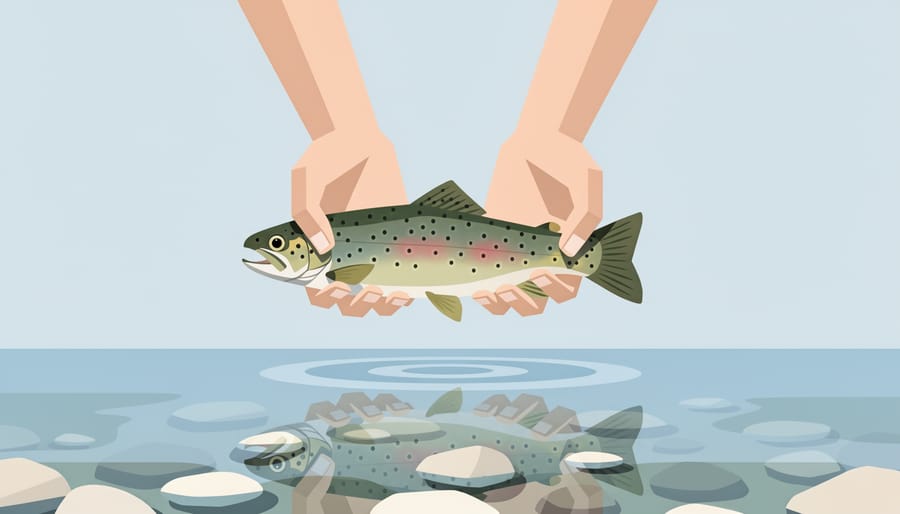
Playing fish was equally humbling. I either horsed them in too fast, breaking them off, or gave them so much slack they’d shake the hook. The middle ground came when a local angler told me to keep my rod tip up and let the rod do the work. When a fish runs, let it take line against your reel’s drag. When it tires, gain line back steadily. No jerking, no death grips on the rod.
Etiquette mistakes still make me cringe when I recall them. I once waded right through a pool another angler was working because I didn’t realize how far his line could reach. Give people space. If someone’s fishing a spot, walk well behind them or ask if it’s okay to fish downstream. Don’t crowd the access points, and for heaven’s sake, don’t walk along the bank kicking rocks into the water where people are fishing.
The good news? Everyone who’s decent at fly fishing has a story like mine. We’ve all tangled our leaders, stepped on our lines, and broken off fish. Each mistake teaches you something that sticks better than any YouTube video could.
Your First Month: A Realistic Timeline
Here’s what actually happened during my first month of fly fishing: I caught exactly three fish, lost twice as many flies to tree branches as to trout, and spent at least half my time untangling bird’s nests in my line. And you know what? That’s completely normal.
Week one should be all about the cast. Spend fifteen minutes daily in your yard with just your rod, line, and a piece of bright yarn where the fly would be. Focus on the rhythm, not distance. By day five, you’ll stop thinking about every motion. By day seven, you’ll land that yarn within a pie-plate sized target maybe four times out of ten. That’s honestly good enough to catch fish.
Week two, hit the water. Lower your expectations dramatically. Your goal isn’t to fill a creel; it’s to make twenty casts without major tangles and to spot where fish might hold. You’ll probably hook bottom more than fish. Perfect. You’re learning to read depth.
By week three, something clicks. Your casts straighten out more often than not. You’ll start seeing rises you missed before. You might even hook a fish, though you’ll likely pull the fly away too fast or give it too much slack. The first fish you actually land will happen when you’re barely paying attention, probably sometime around your fourth or fifth outing.
Week four is when fly fishing stops feeling like work and starts feeling like fishing. You won’t be expert, but you’ll be competent. And that difference makes all the difference.
Here’s the truth I’ve learned after years on the water: every expert you’ve ever admired was once standing exactly where you are right now, fumbling with knots and wondering if they’d ever get the hang of this. The difference between them and you isn’t talent or natural ability. It’s just time and persistence.
I started fly fishing thinking I’d be terrible at it, convinced I was too late, too clumsy, too whatever. Turned out I was right about being terrible at first, but wrong about everything else. The beauty of fly fishing is that it rewards showing up. Every cast, even the awful ones, teaches you something. Every fish you miss makes the next hookup that much sweeter.
And here’s the thing: 2026 is genuinely the best time to start. Between free Orvis classes, beginner programs popping up across Canada, online communities ready to help, and more accessible gear than ever before, the barriers that used to keep people out are crumbling. The sport’s never been more welcoming.
I’d love to hear how your journey unfolds. Subscribe to our newsletter for Canadian fishing updates, seasonal tips, and the kind of practical advice that actually helps you catch fish. Whether you’re in Ontario, Alberta, or anywhere in between, we’re tracking the best waters and latest opportunities for anglers like you.
Now stop reading and go practice that cast.