Why Every Angler Needs a Fishing Hole of Their Own
A fishing hole is a spot where you go to catch fish, but ask any angler and they’ll tell you it’s more than a pin on a map.
A fishing hole is a spot where you go to catch fish, but ask any angler and they’ll tell you it’s more than a pin on a map. It’s the place you trust, the one you return to, the one you sometimes keep to yourself. A TripAdvisor reviewer called a lodge on Vancouver Island “a very special fishing hole,” and a Facebook post mentions “a daughter’s secret fishing hole,” which says plenty about how personal the phrase gets.
The idea is older than any of us. A 2019 study looked at pan-regional fishing in southern Ontario between roughly 1000 CE and 1750 CE, and its title plays on the “local fishing hole” for good reason. People have been choosing and favouring particular waters for a very long time.
So how do you find one of your own? Start small. Shore fishing is restful, rewarding, and open to anyone, with no boat required. Then pay attention to timing. The Old Farmer’s Almanac maps the best fishing days for each month of 2026 to the Moon’s phases, which gives you a simple way to pick your days.
Tried-and-true spot, or something new this season? Either way, the rest of this guide covers how to scout, when to go, what to pack, and how to be a good neighbour on the water.
What ‘Fishing Hole’ Really Means (It’s More Than a Spot on a Map)
Ask five anglers what a fishing hole is and you’ll get five different answers. That’s because it’s less a technical term and more a feeling: familiarity, a bit of ownership, a place that’s yours even though nobody can legally own the water.
You can see the range in how people use it. A reviewer on TripAdvisor calls Rodgers Fishing Lodge in Tahsis, on Vancouver Island, “a very special fishing hole,” which tells you the phrase stretches all the way to a whole lodge that feels like home. Another social post mentions “a daughter’s secret fishing hole,” and you can almost picture the hushed handoff of that knowledge. Then there’s the post asking anglers whether they’re heading to their “tried-and-true fishing hole or seeking out a new location this summer.” Same words, three different moods.
Here’s how I’d break the meaning down:
- Tried-and-true spot
- The home water you return to because it has treated you well, and where you know the bottom, the weather quirks and the best time of day.
- Secret spot
- A place you only share with people you trust, often passed between family or close fishing friends.
- Shore-fishing spot
- A bank, dock or pier you can reach on foot, no boat required.
- Lodge or destination water
- A place you travel to, where the whole experience, not just the fishing, makes it special.
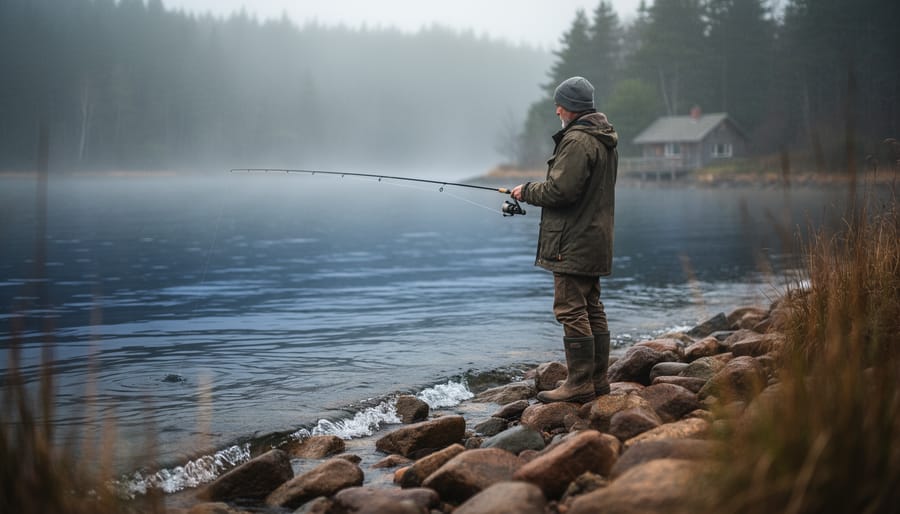
Shore spots deserve a special mention. A Coastal Angler Magazine piece urges readers to “Find Your Own Fishing Hole,” and points out that fishing from the shore can be restful and rewarding, and that anyone can do it. I couldn’t agree more. You don’t need a boat or a big budget, just a rod and a bit of curiosity.
The idea is also much older than social media. Researchers have written about references to “local fishing hole” in a study of southern Ontario, which hints that favourite waters have long been part of how people fish. So when you claim a spot as your own, you’re in good company.
A Long Tradition: Anglers Have Always Had Favourite Waters
The idea of a home water is a lot older than any of us. A 2019 study on local fishing carries the title “Beyond the local fishing hole: A preliminary study of pan-regional fishing in southern Ontario (ca. 1000 CE to 1750 CE).” Just from that title, you can see researchers treating the “local fishing hole” as something worth studying, set against fishing that reaches across a wider region. And the period it covers stretches roughly from the year 1000 to 1750.
I’m not going to pretend to know what the researchers concluded. The title alone tells us the question was being asked about southern Ontario, long before anyone sold a graphite rod or a plastic worm.
Still, it rings true when I think about my own habits. Most of us have a spot we know by heart, the one we drive to without thinking when we’ve only got a free evening. Then, now and then, we load up and head somewhere farther afield, curious about new water. That push and pull between the familiar bank and the unfamiliar shoreline seems to be an old one. Your fishing hole is part of a very long tradition.
How to Find Your Own Fishing Hole in Canada
Start From the Shore
Shore fishing is the easiest way to build a home water. You don’t need a boat, a trailer, or a fat budget, just a rod and a bit of curiosity. The Coastal Angler piece says it best: fishing from the shore can be restful and rewarding, and anyone can do it.
That low barrier is exactly why I started there. A bank or public dock lets you show up often, and showing up often is how a random spot turns into your spot. Here’s how I scout a new one:
- Check local regulations and confirm the access is public, not private property.
- Study a map and the shoreline for points, inlets, docks, and easy footing.
- Visit at different times of day to see how the light and water change.
- Watch for signs of life, like baitfish flickering, birds working, or rings on the surface.
- Jot down quick notes on weather, water level, and what you saw.
- Come back, try a few casts, and refine your approach.
Keep your footing safe, especially on slick rocks or crumbling banks, and pack out whatever you bring in.
Read the Water Like a Local
Fish are lazy. They want food, cover, and an easy place to rest, so they tuck in where the water gives them all three. Learn to spot those places and a plain stretch of shoreline starts to look like a map.
Start with structure, which just means anything that breaks up open water: rocks, sunken logs, docks, fallen trees. Fish use them as hiding spots. Weed edges, where thick plants meet open water, are the same idea, and pike love to wait there.
Next, look for drop-offs, the places where shallow water suddenly gets deeper. Fish slide up to feed, then slip back to safety.
Moving water matters too. A current seam is the line where fast water meets slow, and trout sit just along it, letting the current deliver lunch. Inlets and outlets, where a creek enters or leaves a lake, work the same way.
Stand still for a few minutes and just watch. The water tells you plenty.
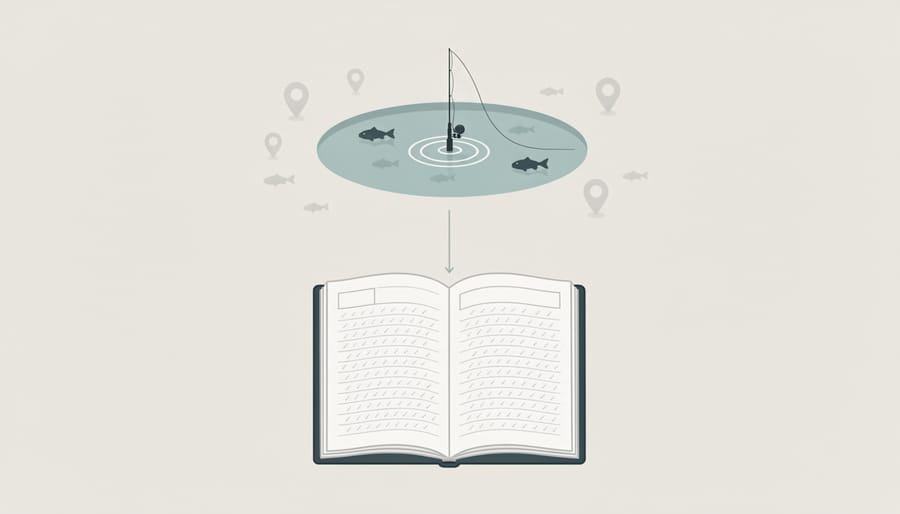
Keep a Simple Logbook
A random spot becomes a reliable one when you stop trusting your memory. For years I told myself I’d remember what worked, and I never did. Then one spring I tucked a cheap waterproof notebook into my tackle box and started jotting down the basics after every trip.
Write down the date, the time you started, the weather, the wind direction and how the water looked, whether clear, murky, high or low. Then add what you used and what actually got bites.
A few months in, the pattern jumped off the page. My best mornings all had light wind and overcast skies, and the fish kept turning up near the same weedy edge. That notebook turned “I think this spot is okay” into a plan I could count on.
Keep it simple. A few quick lines beat a fancy system you’ll abandon.
Timing Your Trip: What the Fishing Calendar Says
Once you’ve picked a spot, the next question is when to show up. Plenty of anglers lean on a fishing calendar for that, and The Old Farmer’s Almanac publishes one built around finding the best fishing days, the times when fish are more likely to bite. Its 2026 calendar maps the best days in each month to the Moon’s phases, so you can glance ahead and plan around them.
I treat it as one tool in the tackle box, not a promise. Fish don’t read calendars. Wind, water temperature, a passing cold front, even how much boat traffic hit the lake the day before can all override what the Moon says. Some of my slowest mornings came on “good” days, and a few of my best came on ones nobody would have circled.
That’s where your own observations earn their keep. If you’re keeping a simple logbook (and you should), jot down the Moon phase next to your notes on weather, time of day and what worked. After a season or two at the same fishing hole, you’ll see whether the calendar lines up with what you actually catch there, or whether your spot has its own rhythm.
Use the calendar to nudge you out the door, then trust your notebook to tell you what’s real.
Gearing Up for a Day at Your Fishing Hole
I learned what to pack the hard way. My first few trips to my shoreline spot, I showed up with one rod, one lure, and zero patience for the mosquitoes. A pike took my only lure, bit through my light line, and I spent the rest of the morning watching the water and wishing I’d brought a spare and some wire. Now I keep a simple, flexible kit, and it works for the bank or a small boat.
| Item | What it does | What to look for | Beginner tip |
|---|---|---|---|
| Rod | Casts and fights the fish | Medium power, moderate-fast action | One rod can cover trout and pike if it’s well balanced |
| Reel | Stores and releases line | Smooth drag, spinning style | Spinning reels forgive tangles better than baitcasters |
| Line and leader | Connects you to the fish | Line weight matched to the rod; tougher leader for toothy fish | Spool fresh line each season |
| Lures and bait | Attracts the bite | A few spoons, spinners and jigs | Carry fewer lures and learn them well |
| Landing net, pliers, safety gear | Handles and releases fish, keeps you safe | Rubber-coated net, long-nose pliers, a lifejacket | Wear the lifejacket on a boat, always |
A few terms are worth unpacking. Rod “action” describes where the rod bends: a fast action bends near the tip and gives quick hook sets, while a slower action bends deeper and cushions the fight. Line weight is the strength rating of your line, and it should sit within the range printed on your rod. If you’re not sure how to choose fishing line, start by matching that rating to the water and the fish you expect.
The leader is a short length of tougher line tied between your main line and the lure. Pike have sharp teeth, so a steel or heavy fluorocarbon leader saves lures (and heartbreak). Trout are shyer, so a lighter, clearer leader gets more bites.
Beyond the rod and reel, I pack bug spray, sunscreen, a small first-aid kit, water, and a bag for any rubbish I find. For a fuller rundown, check this fishing gear checklist before your next outing.
Share the Spot, Protect the Spot
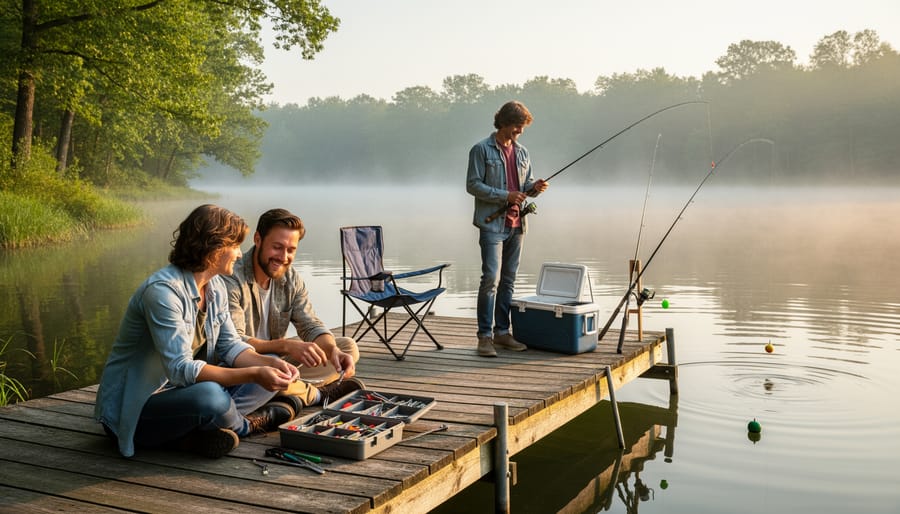
A good fishing hole is worth sharing, but a little care keeps it good. The simplest rule is to leave the place better than you found it. Pack out every bit of line, bait container and snack wrapper, and if you spot someone else’s tangle of mono in the brush, take that home too.
Check the regulations before you go, since limits, seasons and licence rules vary by water, and give fellow anglers plenty of elbow room. If someone’s already working the good seat on the bank, wave hello and move down a bit rather than crowding in.
When you land a fish you plan to release, wet your hands first, keep it low over the water, and get it back in quickly. A fish that’s handled gently will be there for the next visit.
Showing a friend or a kid your favourite spot is one of the real joys of fishing. Keep the group small so the place doesn’t get trampled. And if you’re the newcomer asking where to stand or what to tie on, don’t hold back. Most of us remember being new, and we’re happy to answer.
Fishing Hole FAQs
What counts as a fishing hole?
Pretty much any spot you love and trust. It might be a bend in a creek, a dock, or even a lodge, like the reviewer who called one on Vancouver Island “a very special fishing hole.”
Can a beginner have one?
Absolutely. Fishing from shore is restful and open to anyone, and one patient afternoon is often enough to start a favourite. If you feel jittery, a little preparation and a slow pace can help you calm your nerves before your first cast.
Do I need a boat?
Nope. A bank, pier, or boat launch works fine, and plenty of anglers never leave the shoreline. A boat just gives you more water to explore.
How often should I switch spots?
There’s no rule. Some anglers stay loyal to their tried-and-true hole all season, while others like to seek out somewhere new each summer. A good compromise is to keep a home water and treat one trip in a few as a scouting mission.
Is a lodge fishing hole different from a shore spot?
The word is used the same way for both: a place that feels special to you. A lodge usually brings guides, a boat, and a bed, while a shore spot is more about quiet and self-reliance. Neither is the “real” fishing hole. It’s whichever one you keep coming back to.
So here’s where I land. That quiet shoreline morning taught me something simple: a fishing hole isn’t really about the fish. It’s about knowing a place well enough that it starts to feel like yours.
Maybe you’re already heading to your tried-and-true spot this summer. Or maybe you’re itching to try somewhere new. Both are good answers. The best fishing holes start with one curious afternoon and a willingness to come back and try again.
So pick one spot this season. Just one. Visit it a few times, jot down what you notice, and let it earn a place in your routine. Bring a friend or family member along, and don’t be shy about asking questions. Every angler started out wondering where to cast first.
If you’d like more fishing and outdoor updates from across the country, join the Fishing & Harvesting Canada newsletter. We’d love to have you along, and we’ll see you out on the water.